


Every floriori design starts the same way: Kate in the garden during different times of the day or night, giving her attention to something small.
Observing and celebrating the little lives in her backyard is central to one of Kate's latest projects: a free download for this timely yard sign.
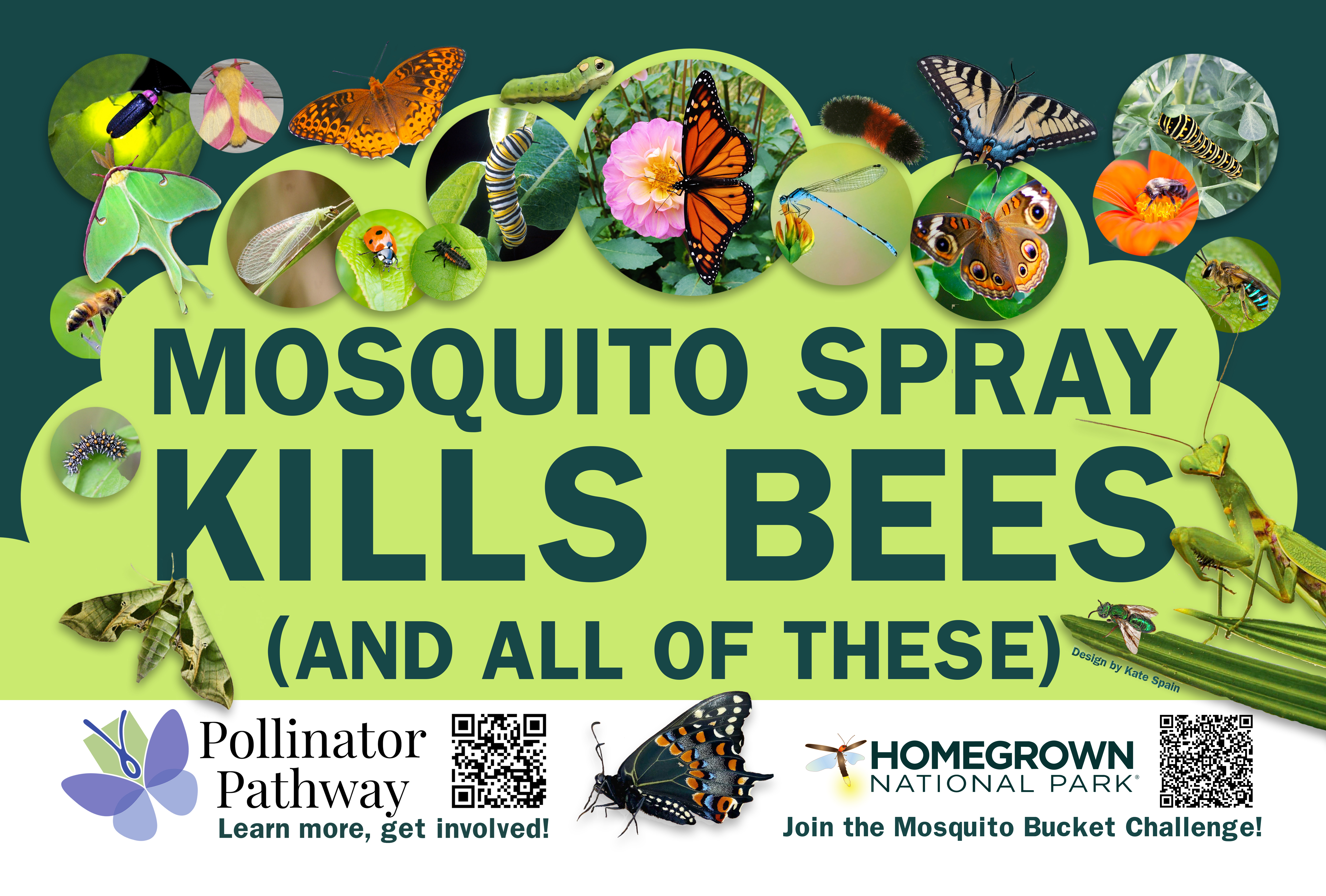
The sign reads: "Mosquito Spray Kills Bees (and all of these)." It wraps that warning in a garland of just some of the pollinators and small wonders that yard sprays destroy.
Kate points to entomologist Doug Tallamy's research showing that broadcast mosquito fogging doesn't meaningfully reduce mosquito populations — but it does reliably kill everything else it comes in contact with.
"It's a trap," Kate says. "People plant beautiful gardens to lure pollinators in, then fog the yard with poison (even organic) that kills them. Homeowners are paying repeatedly for something that doesn't even solve the problem, while it wipes out the natural food web a healthy yard should be supporting."
More than 95% of terrestrial North American bird species rear their young on insects, meaning chemical sprays quietly starve local bird populations. North America has lost nearly 3 billion birds since 1970, largely driven by the loss of insect food sources.
Kate has spent nearly two decades translating her own gardens, local parks, and preserves into original artwork — first for Moda Fabrics, then for her kd spain shop, and most recently for floriori. Her interest in creatures, including insects, goes back to the Ranger Rick Club in grammar school in Mamaroneck, New York, and to hours spent turning over rocks and logs along the Sheldrake River and walking the trails at the Rye Marshlands. That early wonder has stayed with her for life, and it's alive in her own gardens today — in years spent watching bees, butterflies, dragonflies, ladybugs, luna moths, praying mantises, and monarch caterpillars. It's the same firmly rooted world that shows up, transformed, in floriori's botanical prints.
Now Pollinator Pathway and Bee City USA (an initiative of the Xerces Society) are each offering their own co-branded versions for members and site visitors to download and print, with Homegrown National Park lending its logo as a resource for pollinator-safe alternatives. It started smaller than that — Kate first designed it for BEEport!, the Bridgeport-based affiliate of Bee City USA — but the idea has cross-pollinated with other like-minded organizations.
It's also personal in a more literal way. Kate and her husband Pete have kept their own Bridgeport garden pesticide-free for years — it's registered on Pollinator Pathway's interactive map of participating properties — and they've been part of a community-led restoration of a public park near their home since 2018.
"My gardens, our public parks and coastline, and the Aspetuck Land Trust and Audubon preserves — those are some of the special places where my ideas begin, where my imagination lifts off," Kate says. "When you kill the insects, you tear apart the life of these vibrant spaces and systems."
If you've spent time on this site, none of this should be a surprise. It's the same reason floriori is a proud supporter of the National Wildlife Federation's pollinator work, and why our echinacea, firefly, and native-plant stories are featured on the home page alongside our new arrivals. The life in the garden isn't just a pretty backdrop for Kate's original designs — it's much of the reason those designs exist at all.